



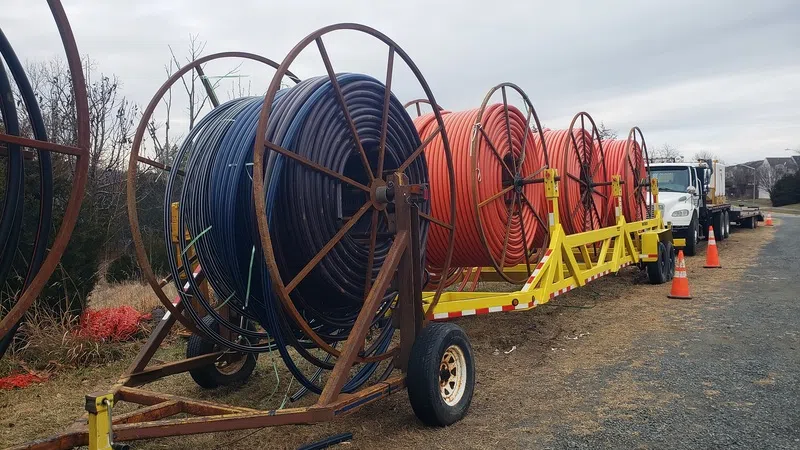
After a lengthy debate and strong opposition from several council members, Clearwater County will move forward with its broadband project as planned.
At its Feb. 13 broadband committee meeting, council was presented with five options for how to proceed.
Option 1 — keeping the $85.1-million project on schedule — was identified as the most cost-effective choice.
Stopping the project was described as high risk, both financially and in terms of the county’s reputation.
The report estimated it would cost taxpayers $18 million to maintain the status quo, while cancelling the program could result in losses ranging from $21 million to $88 million.
Ending the project would also trigger significant liabilities, including termination penalties, potential litigation costs and grant repayments.
Other options included pausing the program, building only in densely populated areas, selling the system, or cancelling portions of the build. All were identified as high risk, with multi-million-dollar losses considered a distinct possibility.
The report noted the project is well underway, with $71.8 million — or 84 per cent — of completion costs already committed through construction contracts and inventory on hand.
Deputy Reeve Drew McKay voiced strong opposition, saying broadband is not a mandated municipal service. McKay also questioned whether broadband is an urgent need in a largely rural county.
“We’re going to be up to our elbows in debt with a huge portion of the county that is completely unserved and unrepresented,” he said.
Reeve Jordon Northcott acknowledged that a full build-out will not bring broadband access to every property in the county.
Ward 1 Coun. Breanne Powell, citing opposition raised during the 2025 election campaign, also expressed concerns. While she ultimately supported continuing the project, Powell said she did so to protect taxpayers from greater financial losses, not because she supports the program itself.
Council voted six to one to continue the project, with McKay opposed.
According to the report, the current plan would make fibre-optic service available to 61 per cent of the county. Once complete, the network will pass 4,399 of the county’s 7,227 homes.
CAO weighs in
Outgoing chief administrative officer Rick Emmons said he has long cautioned council about the risks and complexities of entering the broadband market.
However, Emmons said moving forward is the “responsible thing” to protect the county’s investment.
He urged residents to remain flexible, noting the final cost will not be known until construction is complete.
Emmons also warned that withdrawing from signed contracts and grant agreements would damage the county’s reputation.
Feb. 21 meeting at Dovercourt Hall
The Clearwater County Taxpayers Association will host an open house at Dovercourt Hall on Saturday, Feb. 21.
Marianne Cole, president of the association, said residents are invited to learn about the pros and cons of fibre-optic and satellite service. The group also hopes a county representative will attend to outline the project’s history and explain connection options.
Cole said the association regularly hears from residents who feel there is not enough publicly available information about the broadband project. The open house is intended to help answer those questions.
Cost to taxpayers remains a secondary concern for many residents, Cole added, saying some feel they have not received sufficient financial details.
The open house begins at 1 p.m.
–
RELATED
–











Comments