



Clearwater County has amended its fire protection bylaw to provide greater clarity for residents.
Following lengthy debate and a request for more information on Sept. 8, council approved changes intended to ensure fire-permitting requirements are applied consistently in both the Forest Protection Area (FPA) and the Non-Protection Area of Clearwater County.
“It’s a large concern for us in Clearwater County, whether a neighbour can burn on one side versus a neighbour on the other side who cannot,” said Clearwater Regional Fire Rescue Services (CRFRS) Deputy Fire Chief Evan Stewart, referring to the separate Forest Protection and Non-Protection areas of the county.
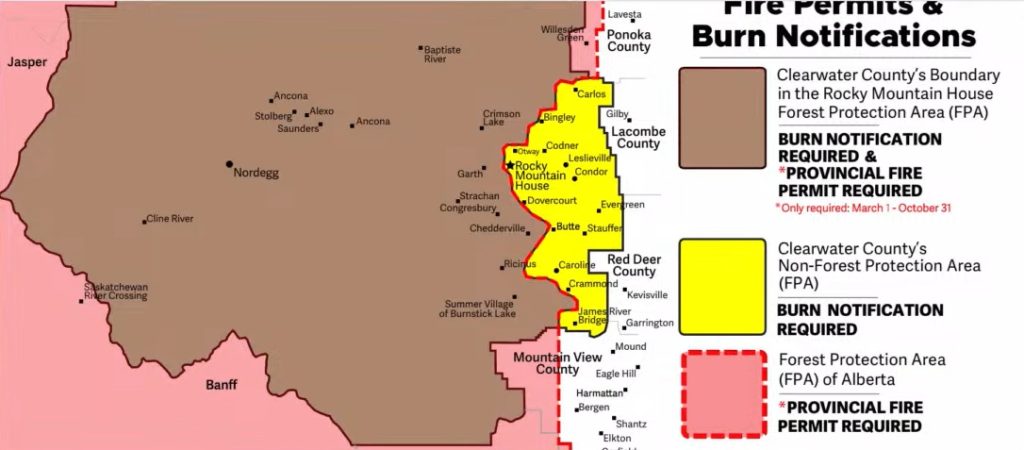
The Forest Protection Area generally includes the mountainous region west of Rocky Mountain House to the Saskatchewan River Crossing area, while the Non-Protection Area covers the eastern end of the county.
The amendments also align with provincial guidelines requiring fire permits during wildfire season, from March 1 to Oct. 31.
Outside wildfire season, residents must now notify the county before igniting a fire.
Fireworks, firecrackers and fire pits
Before passing the bylaw, council sought more information on several issues, including the use of fireworks, firecrackers and fire pits.
Regarding firecrackers, council heard that selling, distributing or discharging them is illegal in Alberta, prompting councillors to retain their prohibition in the bylaw.
For fireworks, council heard that permits would be required year-round under provincial regulations.
Coun. Drew McKay raised concerns about the requirement, questioning the need for a permit to set off fireworks even if there is “three feet of snow” on the ground at New Year’s. Stewart confirmed that, under the bylaw, discharging fireworks in Clearwater County requires a permit year-round, regardless of where they were purchased.
On enforcement, CRFRS Fire Chief Kristofer Heemeryck said the greatest challenge would not be with Clearwater County residents, but with visitors to the West Country who may be unaware of the rules.
He said there may be a grace period during which CRFRS focuses more on education and less on enforcement.
A discussion about fire pit size also prompted lengthy debate.
In presenting the bylaw, CRFRS identified a diameter of one metre as an acceptable fire pit size.
Coun. Lorne Humphrey raised concerns that, depending on which side of the FPA boundary they live on, the changes could make backyard fire pits that residents have had for decades illegal.
Stewart said CRFRS has neither the intention nor the resources to police individual backyard fire pits. He said the restrictions are primarily intended to establish a benchmark in cases where an uncontrolled blaze originates in a fire pit during a period of fire restrictions.
“This change does not make a pit that was legal — illegal,” he said, adding that a clause could be added to require only new fire pits to comply with the rules.
Stewart said the bylaw aims to improve safety without being so restrictive that residents cannot enjoy the rural lifestyle, regardless of where they live in the county.
Ultimately, an amendment established an acceptable fire pit diameter of 1.5 metres.
Heemeryck noted that allowing larger fire pits would accommodate both those in rural areas and those in the backyards of county hamlets, including Leslieville, Nordegg, Caroline, Withrow and Condor.
However, that does not mean smaller fire pits would be prohibited. McKay said he did not expect campgrounds and tourism operators to spend large amounts of money upgrading their fire pits to meet the 1.5 metre standard.
–
RELATED
–
Wintertime burn notifications
The bylaw also requires residents to notify the county before conducting planned burns outside wildfire season.
The wintertime notification requirement prompted questions from McKay, who said a significant public information campaign would be needed to inform West Country residents who have burned without restrictions during the winter for more than 100 years.
Again, Stewart indicated there may be a grace period, with the new rules taking effect March 1, 2027. He added that issuing tickets is at the discretion of bylaw officers, who can defer fines to allow for education.
As part of the changes, council also repealed portions of the former village of Caroline’s community standards bylaw relating to burning to bring the rules in line with the countywide bylaw.
“It will be basically one source of truth whether you need a permit regardless of where you live in Clearwater County, as opposed to having two standards based on a line on a map,” said Stewart.
Council gave third and final reading to the amendments at its Oct. 27 meeting.










Comments