



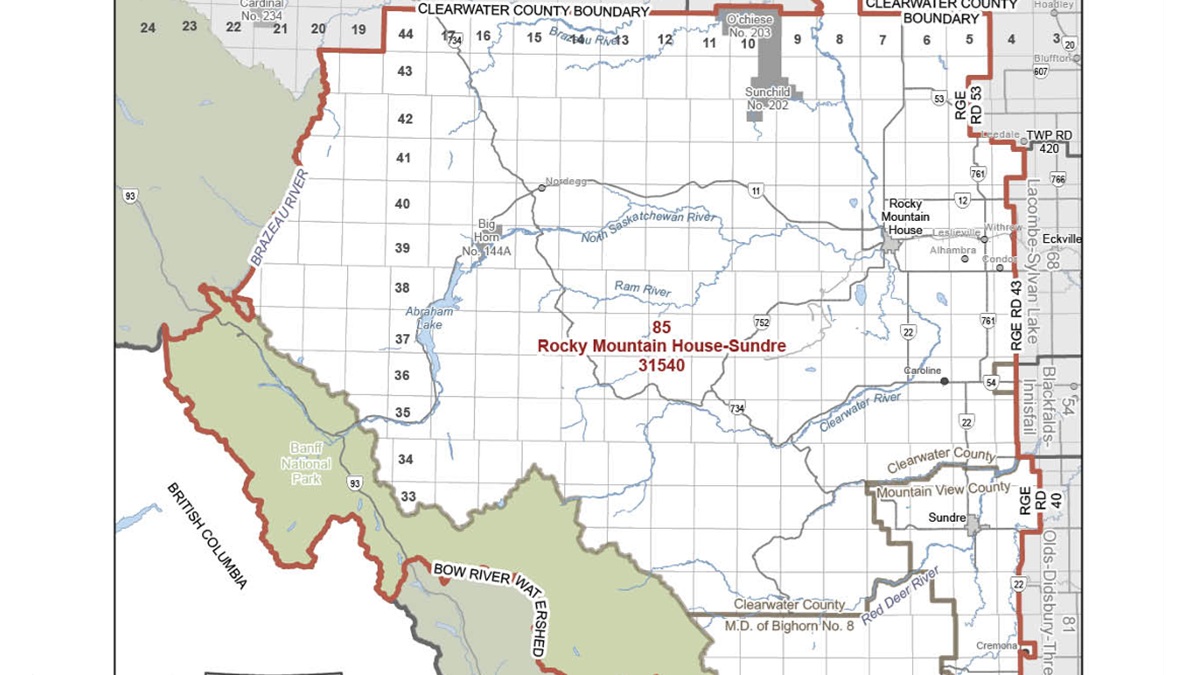
A redrawn West Country map is included in an advisory panel’s recommendations on new provincial electoral boundaries released to the public Monday.
The new maps include 91 ridings, up from the 87 contested in the last provincial election in 2023.
All of Clearwater County and parts of Mountain View County would be included in a new riding called Rocky Mountain House-Sundre.
Parts of the former Rimbey-Rocky Mountain House-Sundre riding would be included in other proposed divisions, including Lacombe-Sylvan Lake, Wetaskiwin-Ponoka and Banff-Canmore-Diamond Valley.
–
RELATED
- Rocky Mountain House-Banff Park Boundary provincial riding proposed
- Motion to redraw Alberta’s electoral maps passes in legislature
- New Alberta electoral boundaries proposed, including possible Lacombe-Rocky riding
–
Better rural representation
A previous report from the 2025-2026 Electoral Boundaries Commission, which recommended 89 ridings, led the commission to “reluctantly” make a number of decisions regarding rural ridings.
Given the dramatic population increases in Edmonton and Calgary, the report recommended two new urban ridings and the absorption of another existing riding into Calgary, leaving enlarged rural ridings, including a proposed new division called Lacombe-Clearwater.
Following the tabling of the report, however, the mayors of Lacombe and Blackfalds expressed displeasure with their municipalities being included in such a large electoral division.
Taking those concerns into consideration, Justice Dallas Miller, who chaired the commission, stated that if the legislature allowed 91 seats, there would be no loss of rural representation outside Calgary and Edmonton.
With the additional wiggle room provided by 91 ridings, the latest map proposal includes the “restoration” of two rural ridings — Rocky Mountain House-Sundre and Lac Ste. Anne. The goal, the report says, is better representation.
Urban-rural hybrid ridings
The report also calls for a number of urban-rural hybrid ridings, such as Calgary-North West-Bearspaw, Calgary-Bow-Springbank, Edmonton-Windermere and Lethbridge-Taber-Warner.
A portion of Red Deer would also be included in Blackfalds-Innisfail to give the riding the population it needs.
Hybrid ridings, the report says, are not without precedent in Alberta, pointing to previous hybrid divisions surrounding cities such as Red Deer and Medicine Hat.
It cautions, however, that hybrid ridings around the two major cities must be carefully considered and should only be created when the urban and rural areas share things such as infrastructure and housing patterns.
MLA says representation — not politics — is the focus
In a previous interview with 94.5 Rewind Radio, Rimbey-Rocky Mountain House-Sundre MLA Jason Nixon said the redrawing of electoral boundaries should focus on representation rather than political advantage.
“I live in one of the most conservative places in all of Alberta — there’s lots of room for MLAs on the conservative side of the aisle to get elected in places like West Central Alberta,” he said.
Nixon said the majority report, released in spring 2026, made clear that population growth across Alberta is shaping considerations around rural representation.
At the time, Nixon expressed opposition to breaking up the Clearwater County area into several different ridings, adding that maintaining unified regional representation is important.
He expressed hope that the committee reviewing the maps would strike the right balance.
NDP lobs gerrymandering claims
Alberta’s Opposition NDP is renewing calls for the United Conservative government to change course on the proposed new riding boundaries.
Leader Naheed Nenshi calls the proposals illegal and unconstitutional, accusing the UCP of trying to give itself an unfair advantage in next year’s election.
The proposals from the advisory panel are expected to be debated in the legislature later this week.
Justice Minister Mickey Amery says the UCP caucus will discuss the report and have more to say at a later date.
What is effective representation?
In redrawing the maps, the commission grappled with the question: What is effective representation?
“Firstly, who is being represented?” the report asks. “Individuals? Communities? Interests? Political parties? Does the elected representative represent his or her constituents or does he or she represent the political party he or she is affiliated with?”
Ultimately, the commission deferred to the Canadian Charter of Rights and Freedoms, which establishes effective representation as an individual right, making the individual the relevant unit of political representation.
However, the report conceded there are understandable differences of opinion about how effective representation is best achieved.
You can read the entire report here.
~ with files from The Canadian Press









Comments